PER Employee Assignments
Description:
Master data report showing the employee demographic information including name, gender SSN, birthdate, age, nationality, effective start date, and additional profile information.
Parameters
Person Full Name, User Name, Person Type, Assignment Organization, Business Group, Effective Date, Flexfield Context
Used tables
fnd_user, per_phones, per_pay_bases, hr_all_organization_units_vl, per_all_people_f, per_person_types_v, per_all_assignments_f, per_assignment_status_types_v, per_jobs_vl, per_all_positions, hr_all_positions_f_tl, per_grades_vl, hr_locations_all, gl_ledgers, per_addresses, fnd_territories_vl, pay_all_payrolls_f
Categories
Dependencies
If you would like to try one of these Oracle EBS SQLs without having Blitz Report installed, note that some of the reports require functions from utility package xxen_util.
Example Report
PER Employee Assignments 03-Aug-2020 171732.xlsx
Report SQL
www.enginatics.com/reports/per-employee-assignments/
Blitz Report™ import options
Case Study & Technical Analysis: PER Employee Assignments Report
Executive Summary
The PER Employee Assignments report is a comprehensive master data report that provides a detailed, date-effective view of employee demographic and assignment information within Oracle Human Resources (HR). It consolidates critical employee profile data, including name, gender, birthdate, and nationality, alongside key assignment details such as organization, job, position, grade, location, and payroll. This report is an indispensable tool for HR professionals, payroll administrators, and managers for workforce analysis, compliance reporting, and maintaining accurate employee records.
Business Challenge
Managing accurate and up-to-date employee information across a dynamic organization is a significant operational challenge. Human Resources and Payroll teams often struggle with:
- Fragmented Employee Data: Core employee demographic data and their various assignment details (job, department, location, pay, etc.) are spread across multiple forms and tables in Oracle HR, making it difficult to get a single, holistic view.
- Historical Data Challenges: Employee assignments change frequently due to promotions, transfers, or reorganizations. Retrieving accurate historical assignment information for a specific date (e.g., for an audit or a past event) is cumbersome with standard tools.
- Compliance and Reporting: Generating accurate headcount reports, organizational charts, or diversity statistics for compliance and internal reporting purposes requires consolidated and easily accessible data.
- Manual Data Verification: Verifying the accuracy of employee records for audits, benefit enrollments, or system integrations often involves manually cross-referencing information, which is inefficient and prone to errors.
The Solution
This report provides a consolidated, date-effective, and easily auditable view of employee assignments, streamlining HR and payroll operations.
- Comprehensive Employee Profile: It presents a single, detailed line for each employee assignment, combining core demographic information with all relevant assignment attributes. This offers an immediate and complete picture of an employee’s status.
- Date-Effective Historical Analysis: The crucial “Effective Date” parameter allows users to view employee assignments as they existed on any given date in the past or present. This is vital for historical analysis, legal compliance, and accurate retrospective reporting.
- Streamlined Workforce Reporting: With flexible filtering options, HR can quickly generate reports for headcount analysis, organizational structure reviews, or specific employee populations, supporting strategic workforce planning.
- Improved Data Quality: By providing an easy way to review all assignment details, the report helps HR professionals identify and correct data inconsistencies proactively, ensuring high data quality across the HR system.
Technical Architecture (High Level)
The report queries core Oracle HR tables, focusing on date-effective employee and assignment data.
- Primary Tables Involved:
per_all_people_f(the central date-effective table for employee demographic data).per_all_assignments_f(the central date-effective table for employee assignment details).hr_all_organization_units_vl(for organization names and hierarchy).per_jobs_vlandper_all_positions(for job and position details).per_assignment_status_types_v(for assignment status descriptions).fnd_user(to link to Oracle users if applicable).
- Logical Relationships: The report uses the
Effective Dateto select the correct records from the date-effectiveper_all_people_fandper_all_assignments_ftables. It then joins these to various lookup and definition tables to present the full, descriptive details of each employee’s assignment at that point in time.
Parameters & Filtering
The report offers flexible parameters for targeted workforce analysis:
- Employee Identification: Filter by
Person Full Name,User Name, or specificPerson Type(e.g., ‘Employee’, ‘Contingent Worker’). - Organizational Context:
Assignment OrganizationandBusiness Groupallow for filtering by specific departments or legal entities. - Effective Date: The most critical parameter, allowing users to define the point in time for which they want to retrieve assignment data.
- Flexfield Context: Enables the inclusion of Descriptive Flexfield (DFF) attributes relevant to the assignment or person.
Performance & Optimization
As a master data report that deals with date-effective tables, it is optimized for efficient retrieval of historical information.
- Date-Effective Filtering: The
Effective Dateparameter is crucial. Oracle’s date-effective tables (_Ftables) are designed and indexed to efficiently retrieve the correct record version for a given date, ensuring fast performance even when querying historical data. - Primary Key Joins: The queries use primary keys (e.g.,
person_id,assignment_id) to perform efficient joins across the various HR tables.
FAQ
1. What is a ‘date-effective’ table in Oracle HR and why is it important for this report?
A date-effective table (like per_all_people_f or per_all_assignments_f) stores historical changes to records. Instead of overwriting data, a new record is created with new effective start and end dates. This report leverages this structure, using the Effective Date parameter to retrieve the exact state of an employee’s record at any given point in time.
2. Can this report show an employee’s salary information?
While the report shows Payrolls, it typically does not directly display sensitive salary information due to security considerations. Salary details are usually stored in separate, more restricted tables and require specific security setups to be reported. However, the framework could be extended to include this data with appropriate access controls.
3. How can I use this report to create an organizational chart? This report provides the foundational data for an organizational chart by listing employees and their reporting organizations/jobs. While it doesn’t graphically render the chart, the hierarchical information (e.g., manager-employee relationships, department structures) can be exported to tools like Excel or specialized charting software to build an organizational chart.
Oracle E-Business Suite Reporting Library
We provide an open source Oracle EBS SQLs as a part of operational and project implementation support toolkits for rapid Excel reports generation.
Blitz Report™ is based on Oracle EBS forms technology, and hence requires minimal training. There are no data or performance limitations since the output files are created directly from the database without going through intermediate file formats such as XML.
Blitz Report can be used as BI Publisher and Oracle Discoverer replacement tool. Standard Oracle BI Publisher and Discoverer reports can also be imported into Blitz Report for immediate output to Excel. Typically, reports can be created and version tracked within hours instead of days. The concurrent request output automatically opens upon completion without the need for re-formatting.
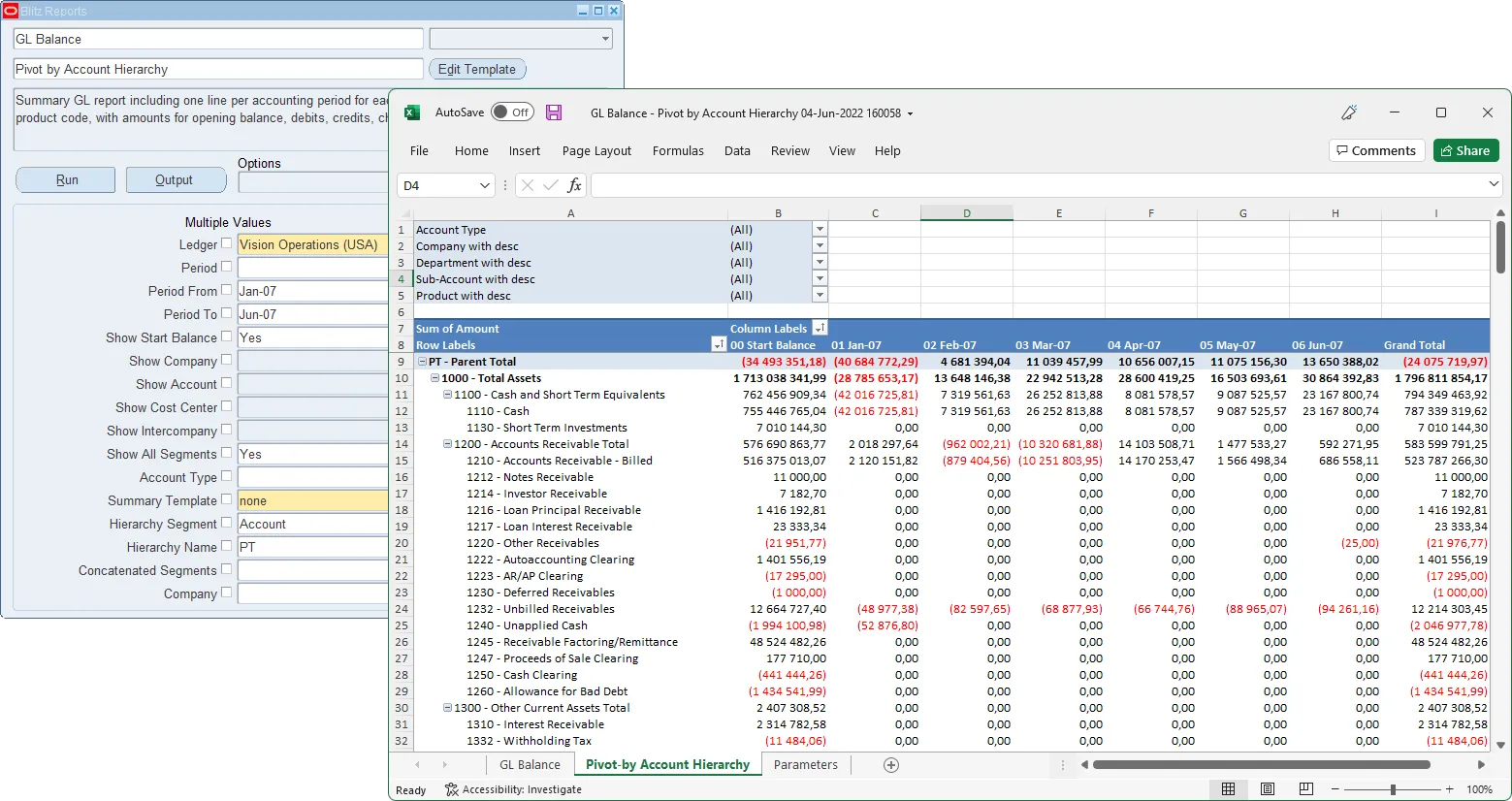
The Filters, Columns, Rows and Values fields are used to create and deliver the data in pivot table format with full drill down to details.
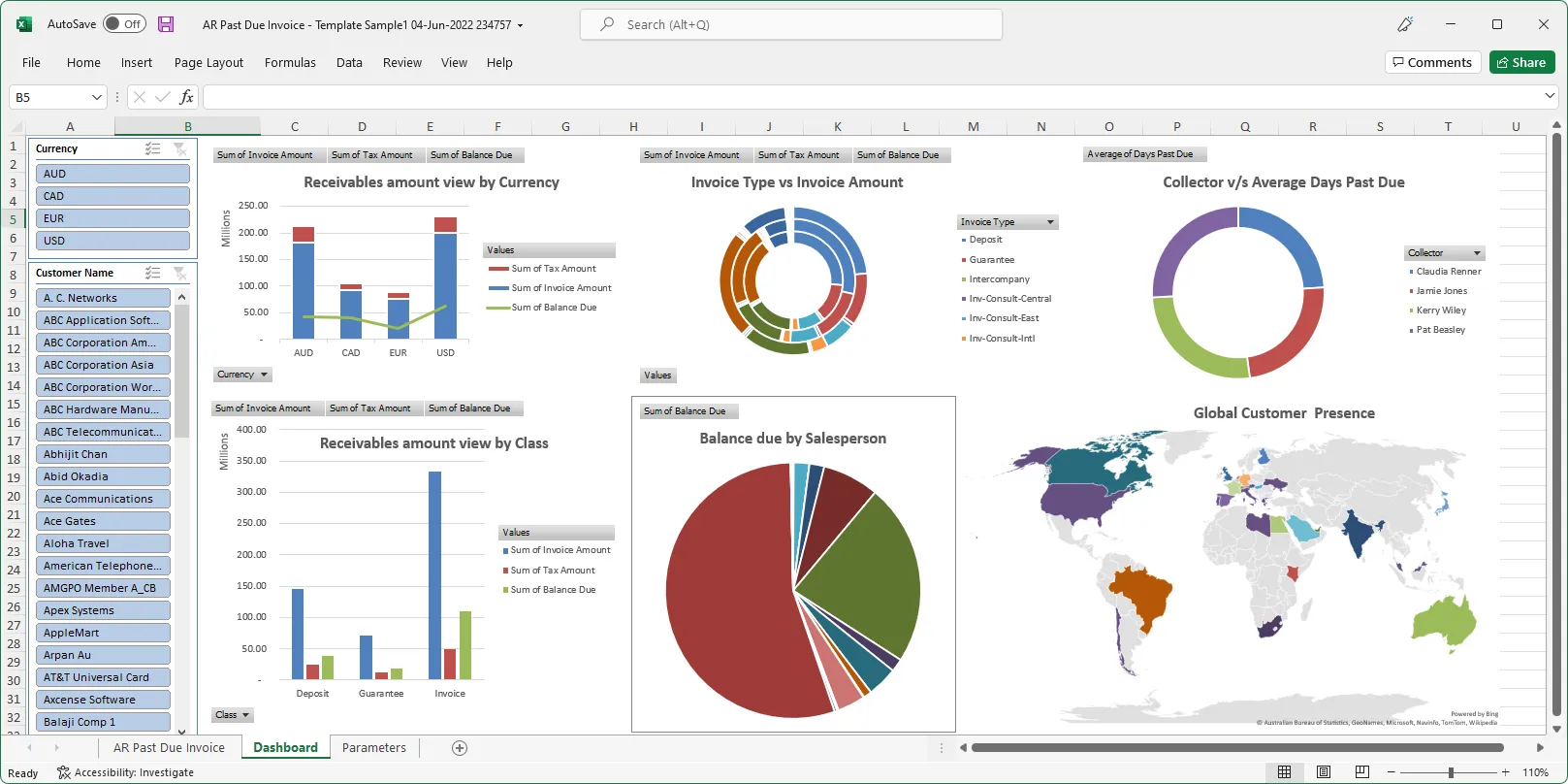
The Excel template upload functionality in Blitz Report allows users to create their own layouts by uploading an Excel template with additional sheets and charts, automatically refreshed when the report runs again. This allows to create custom dashboards and more advanced visualizations of report data.
You can download and use Blitz Report free of charge for your first 30 reports.
The installation and implementation process usually takes less than 1 hour; you can refer to our installation and user guides for specific details.
If you would like to optimize your Oracle EBS implementation and or operational reporting you can visit www.enginatics.com to review great ideas and example usage in blog. Or why not try for yourself in our demo environment.
Useful Links
Blitz Report™ – World’s fastest data upload and reporting for Oracle EBS
Oracle Discoverer replacement – importing worksheets into Blitz Report™
Blitz Report™ Questions & Answers
Supply Chain Hub by Blitz Report™
© 2025 Enginatics